by Linda Bessin | Mar 7, 2023 | Let's Talk About

I was an English Literature major in college because I love to read. My favorite authors to study were the 20th Century authors (of course when I went to college it was still the 20th Century).
There were lots of writers whose works I studied and found amazing and challenging but none more than Thomas Pynchon. He is considered a unique writer in how he combines complex plots and themes about American society combined with over-the-top humor. My favorite of his novels is The Crying of Lot 49.
The plot is about a woman named Oedipa Maas whose life is turned upside down when she is named as the executor of her ex-boyfriend’s estate. She discovers mysteries, conspiracies, and secret organizations similar to the Illuminati but instead run as private postal services. It all seems ridiculous and entertaining in the light of 1966 when it was written and in the late 70’s when I read it.
But in many ways, it is not so ridiculous, especially now in 2023. We have millions of people who look for secret clues in the most mundane things and swear that hidden sources can reveal a diabolical evil. As a student, I was told to question whether Oedipa was seeing what was really there or if she had lost her sanity. It is almost as if the Q followers of today long to be Oedipa on her quest to reveal the trail of hidden countercultural societies and conspiracies to control all of us.
But this theme of “reveal the truth about those in power” permeates our culture. Back in the 70’s we had lots of novels and movies about conspiracies – perhaps the real-life conspiracy of Watergate made the pretend more real. Now we have the fantasy movies about Kingsman: The Secret Service, the secret assassin world of John Wick and so on. These are worlds with societies that seem to exist on the same plane as us but that we cannot see, cannot experience, cannot be a part of. But we know these are fantasy worlds. The problem is that there is a growing number of people who are convinced that real secret worlds exist just like these fantasy ones. And those secret worlds are not populated by secret agents or super assassins but people who are threats to them personally. Because those who hold secret power must be the reason their lives are not what they feel they deserve.
We have many systemic problems that are based on hate, racism, greed and very real economic and social victimization such as the school to prison pipeline. But what excuses do you use when you are taught that you are supposed to benefit from our social and economic systems and you feel you have not? There must be a reason why others have what you don’t have, there must be someone or something to blame for why your life is not what you want it to be. There must be someone to hate so you can avoid being responsible for your own life. Or maybe you are just bored and think these delusions will make your life exciting.
The blame mutates into paranoia and turns into fearing those who are different from you.
For all our history, we have been taught that the other is the enemy and must be “eradicated”, even when they are our neighbors and do us no harm. This paranoia and hatred have now gone into overdrive. With the flimsy excuse of “protecting children”, lives are being destroyed while these manipulators especially target the destruction of the lives of children. Those who profit from harvesting and reaping hate and fear keep changing their narratives to find more and more groups to blame for some evil universe that doesn’t exist. At least Oedipa Maas wasn’t ranting about pedophiles.
And then we keep finding that those who do the most blaming and hating are the ones most often committing the crimes they accuse others of doing. Google “youth pastors molesting”.
Are there powerful conspiracies out there that want to harm us? Sure, the Federalist Society comes to mind. These conspiring groups are the ones who have the power and want to ensure they keep the power and the money that comes with it. The harm and danger are not coming from the powerless. Remember, the motto of Google was “don’t be evil” until, well, that didn’t fit their agenda.
I see the pain of my dear friends who are being targeted with their existence being demonized. They agonize and try to process their fear and anger and my heart breaks. Then I remember that as a Jew I am also a target in today’s United States.
How do we stop this downward spiral? I heard today that 39 states now have anti-trans legislation pending. This has now evolved beyond paranoia into full blown fascism.
Don’t look away. Don’t pretend this doesn’t involve you. Don’t deny what is clearly happening. The call is coming from inside the house. It is only when we all accept that this darkness is here and doing battle that we can fight it. Because we can only defeat the paranoia and hate if we unite as one.
3/7/23

by Linda Bessin | Feb 25, 2023 | Let's Talk About

There are lots of reasons why people become what we call “late bloomers” – we all have our own challenges to overcome to realize our true potential. Some barriers are financial, some are emotional, some are social and so on. And everyone defines “late” in different ways.
I found this post by Ayesha A. Siddiqi named Advice: How Do I Make Up For My Lost Years to be powerful. The person seeking advice from Siddiqi laments having debilitating depression in their 20’s and now, in their 30’s and with the depression under control, they feel like so much time has been lost to them.
What are our expectations for ourselves? What are the expectations that others have for us? My mother had a mindset similar to many in her generation and when I was in my 20’s she pushed me to find a husband and start a family. She was in a panic when I hit my late 20’s without doing either of these. I saw my 20’s as a time to explore the freedom I had just obtained as an adult. Once I did that and got to know myself through doing that, I understood that my mother’s expectations were not mine and my path would be drastically different. In my 20’s I had low paying 9-5 jobs that allowed me my evenings and weekends to enjoy being young in LA in the 1980’s and it was great.
Once I hit 30, I decided that I should stop exploring and start to figure out what I wanted to do when I grew up. I would not have found a career that I loved if I hadn’t “wasted” the previous 10 years. I spent that time determining what I wanted. I then spent my 30’s establishing myself in a career I loved, climbing the company ladder, and deciding my ambitions. Lots of travel was involved – my territory at one point was San Luis Obispo down to San Diego and east to the Arizona border. I flew to the company headquarters monthly and this was all new to me and increased my confidence. There were people around me who started climbing this ladder in their 20’s. But I knew that I would not have been ready then to take on that challenge at that time. I needed to reach the point where I was ready to confront my insecurities rather than agonizing over them.
But there were and still are moments I think if things had been different in my childhood, if I had been raised to have confidence and see an unlimited potential in myself, my life might have been easier or better. Siddiqi slaps that regret and second-guessing out of the way.
Siddiqi has so many gems of wisdom in her post:
“Things take the time they need and happen when they can. There’s nothing “late” or “early” about the timeline of your life unless you were given a call sheet at birth.”
“We all would be different people in different circumstances. And it can be tempting to cope with difficult circumstances by mourning the people we would have been without them. But you cannot organize your days around regret. Despite the ways we’re shaped by trauma, we are more than just what trauma leaves behind … Stop looking for yourself in the past, you don’t live there anymore.”
It is so easy to fall into the “woulda coulda shoulda” mindset. We can let a sense of loss for what might have been possible for us become so overwhelming that we lose sight of what we have today and the potential of tomorrow.
“If there are ways to waste [time], surely regret is one of them. Not because we should live our lives in fear of it (which equally allows it to direct your life), but because it postpones acceptance. It pulls you away from the time you still have available.”
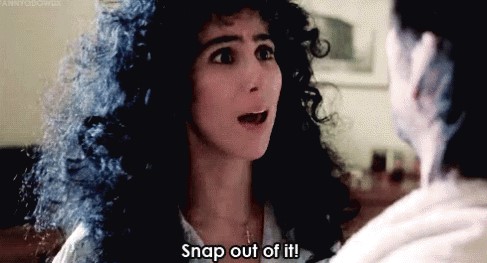
She concludes with this statement, which is basically a way of saying what Cher’s character meant in Moonstruck when she did THIS:
https://youtu.be/0x-fkSYDtUY
(Loretta’s story is a great example of “making up for lost time”.)
“The value you’re seeking to recover from your past exists in the life you’re living now. All you owe is continuing to take good care of yourself. And you owe it to the person who succeeded in the only thing they owed you—they survived.”
I am proud of what I have accomplished and what I hope to still accomplish. But I still find myself thinking about the different paths that might have been open to me if I had been different in this way or that way. I suppose I will have to keep giving myself a Cher Slap. And that’s ok too.
Siddiqi includes this video in her post and it is perfection. If you were a different person then you would not be you. Enjoy and appreciate who you are.
https://youtu.be/95mttyEQyfw
2/25/23

by Linda Bessin | Jan 31, 2023 | Let's Talk About

I went a small women’s liberal arts college in Southern California. When I attended in the late 70’s and early 80’s, the student body consisted primarily of wealthy white young women who were not there to prepare for careers. They drove luxury cars and wore designer clothing and were there to meet other members of the elite. The college had a mocking reputation of granting an “Mrs.” degree, meaning most of the women were there to find an equally wealthy husband. Looking at many of my peers today, it is clear, whether they admitted it then or not, that was indeed what they were there for.
Unlike most of the student body, I worked through my college years and bought my clothing at Army surplus and second-hand stores. I walked where I needed to go and stayed within my means. In return I got a fantastic education and my years in college prepared me for life in ways that I didn’t realize until years later. The professors were accomplished leaders in their fields. I certainly realize and appreciate the quality of the education I received.
While I was there, I was not accepted into that elite world and that suited me just fine. My friends and I welcomed all fellow outcasts to join us at our table in the dining hall and hang out if they wanted to.
There was one young woman I will call Jessie. She was overweight and didn’t shower much. She dressed, well, even worse than I did. She knew she was welcome to be with us and we provided a safe space. But I didn’t quite know what to make of her. While she was smart and creative, her communication skills were not good. The only topic she could only talk about was herself and she did so in a babbling way. Looking back, I now question if she was on the spectrum or if she had experienced major trauma already in her life that stunted her permanently. I didn’t know if she was on scholarship or was able to pay her way. We knew very little about her other than she had a big crush on Timothy Hutton and she was taking art classes. She really couldn’t engage in conversation beyond that.
Jessie never reached out in friendship to any of us and being young we didn’t question why and just gave her the space she wanted. And since she was someone I couldn’t relate to, I didn’t pursue friendship either. Once we all graduated I never heard about her again. Until today.
I read through the latest edition of the alumni magazine which has updates on life events including deaths. Listed in the Death section was Jessie who died last year.
I looked her up on Google to see what had happened and how her life had been. All I could find was an obituary written by her family. There was no information about her life in that obituary other than a brief paragraph.
Her family described her life as going to college, studying photography and graphic art, a lifelong reader, and during her last years, acting as caretaker for her elderly father. Nothing more.
Her father survives her and is listed as living in the Midwest where Jessie passed away. She also had 5 siblings yet she alone took care of the father. What struck me was the final sentence: “Jessie will be buried in the family plot in Ojai”. I thought, what does that mean – is this a wealthy family? Why is the family plot in Ojai when none of the family lives in that area? Was she at my college because this is where that particular wealthy family sent family members?
The obituary is on a page of a mortuary website where people can share their thoughts and memories. There are no posts – none from her siblings nor from the “numerous nieces and nephews” the obituary mentions. The mortuary produced a tribute book and not one person contributed a tribute.
Today I think about Jessie and all of us who crossed paths with Jessie during that time in college. What world was she supposed to belong to, what world was she capable of living in and what world did she choose. Did her family expect her to be part of that world of the wealthy but she knew she never could or would be. I hope the silence on the tribute page doesn’t reflect how she was treated during her life. I wish I could know what world she chose to live in during these decades of her brief life.
In the picture of her on the obituary she looks almost exactly the same as she did in college except for, you know, being 45 years older. She died young and I hope her life was filled with the joy she found through photography, graphic art and reading. Things that can be enjoyed fully whether or not you are wealthy.
1/30/23